Showing posts with label Jeanie Wilson. Show all posts

Friday, July 22, 2016

Annie Newcomer Interviews Jeanie Wilson about poet Thomas Zvi Wilson

       
Thank you to Annie Newcomber for permission to reprint this interview she did with Jeanie Wilson about her husband, Thomas Zvi Wilson (1931-2012). The Thomas Zvi Wilson Reading Series of The Writers Place presented a tenth anniversary celebration of the publication of his and Jeanie's The Door into the Dream (Mid-America Press, 2006). The series Facebook page describes the series: "Mr. Wilson’s objective was to broaden outreach for The Writers Place and create an additional venue for poetry and prose writers to read. After Thomas’ health failed, his wife Jeanie Wilson, an emeritus board member of TWP and poetry and short story writer, curates this popular reading series in his memory." The free series, founded in 2001, is third Tuesdays of the month. The readings take place at Johnson County Central Resource Library, 6-8 p.m., 9875 W. 87th Street in Overland Park, Ks., 913-826-4600.
Jeanie, what led your husband to the idea of developing the reading series?  His primary 
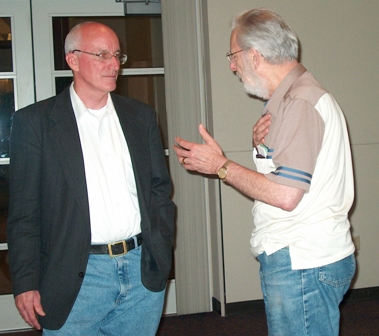
Jeanie & Thomas Zvi Wilson
mission was simple: to help writers. He believed, in part, an additional venue would provide more opportunities for writers to read. Many writers who have read in this program have gone on to publish books of poetry and seasoned poets have shared from their already published works.
How did he become involved in The Writers Place (TWP)? Tom had turned his attention from visual arts to poetry and wanted to become involved in TWP, the rising hub of the literary community in Kansas City. Eventually, he served on the Board of Directors and eventually as treasurer.
What were some of his dreams for the Kansas City writing community? At the time, there were separate pockets of writers and locations, and Tom had hoped to provide opportunities for these various entities to collaborate and to bring writers together to share their writing. I believe that collaboration is happening with the help of so many writers, organizations, and volunteers.
Did he see himself as an artist first or equally as a poet and an artist? I believe for Tom the identities were integral and each art form fed off the other.
What do people not know about Thomas that you wish was known? As much as he loved to write, he had a passion to help other people: writers, visual artists, and inmates at Lansing Prison. It was a longtime struggle in his division of time. Also, he was unique in that he was able to use both left and right sides of his brain, synthesizing in poetry and art.
Do you have a favorite poem that Thomas cherished? Might you share?  I have selected a poem by Mark Strand, which Tom and I both treasured because it spoke of love late in life, which was our miracle.
 Even this late it happens:
the coming of love, the coming of light.
You wake and the candles are lit as if by themselves,
stars gather, dreams pour into your pillows,
sending up warm bouquets of air.
Even this late the bones of the body shine
and tomorrow’s dust flares into light. . . .
 How did Thomas suggest that poets could best hone their craft? He recommended and practiced that a poet read other poetry, write constantly and revise methodically.  Some of his poems had been revised 40-50 times.
What did he want his audience to look like? What people was he trying to draw to the readings? All ages and ethnicities. The ideal audience member was hungry to hear the poems and to learn something new from the reading that evening.
What made him most proud of the Reading Series? He was very pleased when a new writer excelled and went on to publish.
What were some of his opinions on poetry? The poem should communicate the human experience or artistic idea to the reader. He had a great deal of poems on the artist, Edward Hopper. Poetry and art crisscrossed in his poetry.
Can you share a little bit about Thomas’ life and background? He was born in 1931 in New York. His family lived in a Jewish community. His parents abandoned him when he was about five to seven years old. He was extremely intelligent and thirsted for life in and outside the community. The community members raised him until at 14. He ran away and started a new life of his own. To him life itself was a gift not to be wasted. He never stopped learning and creating in some manner.
Poets often ask me how you select your readers. What do you suggest to someone who has this aspiration and goal? If they are interested in reading, I like to visit with them and read some of their work. In some cases, I know the individual and their work already. Similar to Tom, I do not require that a writer has published a book prior to reading. He enjoyed helping new writers of all ages and backgrounds.
What inspired you and Thomas to write your antiphonal poems? Initially Tom and I had paired our poems around a common theme or word and performed readings with these paired poems. Our publisher/editor, the late Robert Jones, approached us and asked us to write a book of these paired poems.
 What advice would he give today’s poet? First and foremost, he valued life and did not want to waste a moment or day. Regarding poetry, once again, he would recommend to read other poets, write constantly, and revise the poem diligently.
What do you see as Thomas’ legacy? Tom served as a model of friendship in helping writers and artists advance their art and writing. He set the standard in how writers should treat one another. The Thomas Zvi Wilson Reading Series serves as a vehicle to provide opportunities for writers and poets and stands as a testament to this extraordinary man. June, 2016

Annie Newcomer lives in Prairie Village, Kansas, with her husband of thirty-six years, David. Her two daughters inspire her to tackle new adventures such as triathlons and charity runs. She loves to travel and has had wonderful opportunities to see the world and to make friends from different cultures. She loves her involvement with Compassion International and sponsors a dear and serious young girl from India who wants to become a doctor and a young athletic boy in the Dominican Republic who aspires to play for the Boston Red Sox one day. Annie is blessed to have friends in Kansas City who support her writing interests. 

Sunday, February 14, 2016

Thomas Zvi Wilson Reading Series Announces 2016 Readers

2016 Schedule Thomas Zvi Wilson Reading Series
6 pm at Johnson County Central Library  
9875 W 87th St, Overland Park, KS 66212

February 16, 2016 Arts in Prison—Readers (Host, Arlin Buyert)
http://www.kansascity.com/entertainment/books/article59753426.html

Thomas Zvi and Jeanie Wilson, 2001
March 15, 2016 Maryfrances Wagner, Bill Trowbridge 

April 19, 2016 Michael Harty, Walter Bargen 

May 3, 2016 Dennis Etzel, Roderick Townley 

May 17, 2016 Catherine Anderson, Catherine Browder 

June 21, 2016 Jo McDougall, Lindsey Martin Bowen 

July 19, 2016 Jeanie Wilson and other poets reading Thomas Zvi Wilson’s poetry 

August 16, 2016 Robert Stewart, Greg Field 

September 20, 2016 Annie Newcomer, Alan Proctor 

October 18, 2016 Susan Rieke, Elizabeth Uppman

Wednesday, March 7, 2012

Kansas City Poet Thomas Zvi Wilson Dies

Wichita poet Michael Poage listens to Thomas Zvi Wilson
Jeanie Wilson let friends know that Thomas Zvi Wilson, her husband, died today at 12:30 pm, March 7, 2012. He influenced many Kansas City area writers as a poet, writing coach, and friend. All of us who knew him continue his life through our memories of him, and through the words he shared. To keep his fire burning, here is one of my favorites of his poems, reprinted with permission from the book The Door into the Dream (The Mid-America Press 2006):

The Winter Dream

is what we must imagine:
Whoever you are, night at last
drops you in its pocket.

In that dark vastness,
every electric bulb that's glimpsed
through  farmhouse window
is a likely star soon to burn out.

From there the roads go
nowhere, or slam into a wall
that refuses what we must imagine:
only seamless night.

For biographical information and another poem: http://deniselow.blogspot.com/2008/04/ad-astra-poetry-project-14-thomas-zvi.html

Tuesday, April 28, 2009

Ad Astra Poetry Contest Winners: Ks. Gardens

My Mother's Garden
by
Jeanie Wilson

Wander down
her garden paths—
smell of lavender
and rosemary,
sound of easy laughter
riding on sunlit air.
It is as if she
is running just ahead—
as if her skirt
has just flicked
out of sight around the corner.
#
The Environmentalists Burn the Prairie
by
Linda Rodriguez

I abandon,
like Aeneas, fleeing their set fire,
as if from Dido
and chaos, passionate
and fertile as the void was fertile
enough in Genesis to spawn life
down to the last
caterpillar-chewed leaf.

I surrender
when the burning grass falls around me
as the hot winds surge and fail.
Wrapped in a tangle
of pea-vines and walled in
by man-high grass, I welcome
the roar and the smoke and the flame
too much, I fear.

I circle
behind the fireline
and walk on steaming cinders
where a world had been.
Because of the flames, they tell me,
in spring the gayfeather will shoot up
and a thousand tiny orchids will hide
among the roots of renewed grasses.

I escape
to plant my Roman garden in the spring
in measured, lawful rows.
In classic tradition, I limit creation
to that scrap
I control.
#
My garden
by
Judith Roitman

Columbine.
Chiggers. Poison ivy.
Thank God, worms.

Tulips & daffodils.
Pray for mountain rue.

Sticky weed. Burrs.
Thornystem weed (horse nettle?)
Dandelions.

Vinca smothered by euonymus along the sidewalk —
Root out the euonymus! Turn it into lawn! Yes!

Vinca carpet along the creek
slowly taking over all empty space.

Lamium almost smothered by vinca along the creek:
only two left.

Coreopsis = moon flower holding off vinca encroachment.

Daffodils in shade.
Hosta in sun.

Oops, backwards. Do-over.

Bunches & bunches & bunches of lilacs.
Rose of Sharon — my childhood home.

Red.
Buds.

Phlox — alternate purple and pink.
Two rose bushes, a gift.
(Now we have to feed them.)

For Sythia, always for Sythia.
What about Alice? Mary? Don’t they deserve something?

Moneywort in two shades intertwined.
Sedum (2 kinds) & maiden pink & chrysanthemummummums.

White pine. Silver birch. Pin oak. Maple. Chinese elm.
Juniper bushes in front, 4 box hedges in back.

Lots of pine trees, 2 of them spindly & not going to last long.
Weed trees along the creek & the east side of the property.

Snow-in-summer (say it fast 10 times).

“If grass won’t grow there
nothing else will.”

But the peonies oh the peonies
the peonies always do all right.
#
Pickling
by
Angela Hine

I. Morning
We pick pans and pans of cucumbers,
their spines pricking the skin
on the insides of our arms,

drops of sweet water budding
at the point where fruit left vine.

Bees as eager as we
to harvest from the blooms
buzz in and around the shaded leaves,

the shadow of my hand
crossing their paths.

II. Afternoon
We pull plastic sheeting off
the old window unit and coax it
to blow its musty, dusty air.

We wash and slice, vinegar and salt,
add mustard, orange-gold turmeric, dill,
pull clean, blue-green Ball jars
from the oven, and pickle
in the weight of the heated kitchen.

Bronze lids pop and seal
in long rows across the counter.

III. Evening
We water the plants, winding
the long hose out from the leaky
faucet behind the garage,

past the onions and strawberries,
through cabbages and past
the row of clustered peppers,
next to the budding okra, planted late.

The earth opens up and drinks
our water, and I drink from the hose,

fresh summer water that tastes like metal
and rubber, sweet dirt and sweat.

IV. Night
We come inside when the sun
has its late setting and june bugs
fly blind into window screens.

We wash our feet in the bathtub,
watch the dirt and dust break loose
and flow down the drain,

dry our feet on towels
dried rough on the clothesline,
wipe our sunburned necks of sweat.

Some nights, the washing is too much;
in the heat, the long day, we go to sleep
and take the dirt to bed with us.
#
Vacant Lot - Colony, KS
by
Max Yoho

Hollyhocks grew here,
fibrous and pungent.

Jonquils, pushy as teenagers,
rushed up through the snow.

Here! The yellow rosebush.
Grandma called it “Nebuchadnezzar.”

Here was the garden,
where her gold wedding band
slipped from her slender finger
and was planted among peas or radishes.

Here, I secretly watched, each spring,
for the first green shoots
of a Wedding Band Bush.

Alone now,
at the yellow rosebush,
I say our magic words:
“Your old slippers, my old shoes,
Nebuchadnezzar, the King of the Jews.”

#

Tuesday, April 21, 2009

AAPP Contest 5 Kansas Houses: Winners

THE SCREEN PORCH
by
Jeanie Wilson (Olathe)

A wicker chair cradles me, rocks me to rhythms
of cicadas and crickets, bull frogs down at the pond.
Two whippoorwills cry around the house.
Night creeps in like a stain.

My great-great grandmother sat on this porch,
looked out across the fields, rested from the day’s heat.
She has passed away along with my grandmother,
grandfather, and my aunt.

I am caught, tangled around by their doings,
their lives—a weaving of threads in the air of this house.
In the darkness, I listen to the sounds of their voices,
watch the parade of faces.
#
THE HOUSE ON OSAGE STREET
by
Thomas Reynolds (Overland Park)

In my grandmother’s mind,
The streets were not crooked.

The house where she lived as a child
Stood as resolute as Sander’s Hill.

Sidewalks never cracked,
And mother’s backs were never broken.

The milk truck still pulled up out front,
And bottles waited patiently on steps.

Doors never burst open with anger,
Slamming repeatedly in the August air.

Mothers never cried at midnight,
And fathers, even if so inclined,

Never lost their paychecks in card games,
Wandering the crooked streets until dawn.

Lights were out across town by eleven,
Except for maybe in some upstairs window,

Where one small girl read by candlelight,
And occasionally looked out at the full moon,

Thanking God for the life she was given,
That somehow it would go on forever,

Here with rolling hills as backdrop
And every bad memory erased.

#
Many Mansions but One for Kansas
by
Daniel Pohl (Hutchinson)

You must take the tour at Saint
Fidelis to become one of the sixteen
Thousand, yearly, transformed by
Devoted architecture of German
Masters, voted by the people one
Of the eight wonders that live here
On the plains to know it is true.

You need to exit at Victoria from I-70,
From its hurried life, its ego, and the
Mischief it causes, to slow down, to
Listen to the guide explain it, once,
Proclaimed by William Jennings Bryan
As the “Cathedral of the Plains” though
No Bishop ever resided there at the
“Largest Church West of the Mississippi.”

You have to learn about the Biblical
Austrian art, the crafted Italian marble
Altar, the storied windows above it,
Especially on a sunny afternoon that
Will pop the colors to burn memory
Onto the inside of your soul, and
How the eye never is meant to focus
But wander from transit to nave, from
Ceiling to the Stations of the Cross.

Then after, sit, mid-sanctuary, still,
Unmoved, and take the time, because
There is none, and listen to your heart,
To the limestone, to the spirit of the place,
A house big enough to let you know
There is something greater than you.
#
Something Older
by
Judith G. Levy (Lawrence)

It's a 70's home I say,
joking away my longing
for something older,

like my grandmother's arms folding me into sleep.

Yes, I tell a faraway friend,
I'm settling in here,
(but the house sings an unfamiliar
song at night)

And all the while a plump robin
pokes at twigs in my yard
and plucks a perfect one,
nesting without fuss or grief.
#
House In The Middle Of A Field
by
Greg German (Kansas City, Ks.)

I know of no one who has lived
here. And it has been here forever,
a pivot we cramp machinery around
behind a full-throttled tractor.
The house could have been a corner post
so tight set it made no difference
how taut or in what direction a wire
stretched. The foundation has settled.
Wind has chiseled the excitement
out of the wood, and the sun has left it
grey. Its shingles are receding.
There are no curtains. The front door
is gone, so it must be open. Inside
I mingle with the musty scents eroding
from the crisp millers and mummified mice
hidden behind the layered, pastel paper
wilting from the walls. Children
drift through bedroom doors playing
with antique toys. Screened
by a common farmer face, a man sits
on his kitchen chair. He stares
beyond a woman in a cotton dress
into clouds that might not
be rain. I have done my duty.
And mine are the last boots
to arouse the dusty lull spread
across this cold wood floor.
On the windward side of the house
dad announces there is no better time
than now. I stand back. He lights
a match. Flames lean from windows,
tattered flags at full mast.

#