Showing posts with label Michael Poage. Show all posts

Saturday, May 20, 2017

Denise Low Reviews Michael Poage's Selected Poems

Comments by Denise Low
When I met Michael Poage 20 years ago, I snapped to attention when he mentioned his study with Richard
Hugo and Madeleine DeFrees in Montana. Their tandem tenure at the MFA program produced some of my favorite writers, like James Welch, Sandra Alcosser, Kim Barnes, Art Homer and Richard Robbins. Poage has his own voice and technique, well-honed by his training. Gerard Manly Hopkins is an author whose works suggest Poage’s lines. Each poem has an internal working, like a separate clockwork. They are encriptions that intrigue readers to follow intriguing sequences where paradox upsets balance. His early books of poetry are letterpress beauties from Black Stone Press, Handbook of Ornament and Born. Since these early works, he continues to develop his handiwork, with a more global framework. He describes his travels, often for humanitarian and/or literary projects:
“For the past 40-plus years I have continued to write and have given readings and workshops in several states as well as in Mexico, Latvia, and Bosnia & Herzegovina.. . I also participate in progressive social justice activities in the U.S. and abroad.  I was part of the Gaza Freedom March in Cairo in 2009, went to the West Bank in 2010, and traveled to the Gaza Strip with Physicians for Social Responsibility in April, 2012 working as a trauma counselor. . . . I work with the Kansas Coalition Against the Death Penalty, have done community development work in northwest Mexico, taught English and worked with Church World Service in Bosnia.”
Madeline DeFrees endorsed his recent collection The Average Level of Happiness: “These terrifyingly honest poems confront the essential loneliness of the human condition…that of the ghost fish, Miss Kansas, or a suicide bomber.  And, as always the poems are full of surprises generated by the simplest of everyday occurrences such as starting a new address book or forgetting what day of the week it is.”
Here are two sample poems by Michael Poage, reprinted with permission from his Human Ink: The First Five Books 1975-2005 (Wichita: Blue Cedar Press, 2017)

NOT EVEN IN A BLUE MOON

There are continents
looking for a sign
of faithfulness
to the end.
And there is you.
The walk you promised
yourself along the edge
of one land mass
also brings you close
to your voyage.  My
adventure will be to sit
on this front porch
and taste the passion
of the thunderstorm
rolling across the prairie
from the west,
from all we never touched.

THE BLACK SEA
It looked blue to me
but as you all know
I have been wrong
before.  No one I
talked to on the
Turkish coast could
give an explanation
for the name.  It seems
one of those mysteries
we face when we are
the least bit alert
or very lost.  When climbing
out of our painful
selves we often will
attempt a bargain, make
a deal between where
we have been and what
we can’t quite see
ahead.  In this case
trying to bluff is very
dangerous.  None of us
really has what some
call a “poker face.”
We give it dead away.
Just go the way of the
Prophet named Oti
(we think), and this wisdom:
“Poetry is like driving a truck
5,000 miles to a town
worse than yours.”

Michael Poage has worked a variety of jobs: grocery store clerk, manual laborer, elementary school teacher, office clerk, sheep and cattle rancher in Montana, and 25 years as pastor to three United Church of Christ congregations in Kansas. He currently is an instructor of English at the Intensive English Language Center, Wichita State University, where he lives with is wife Gretchen Eick. He has ten collections of poems published and a selected works, Human Ink (Blue Cedar Press, 2017). B.A., Westmont College, 1967; MFA, U. of Montana, 1973; M.Div., San Francisco Theological Seminary, 1985 www.michaelpoage.com  Michael Poage
PO Box 48715  Wichita, KS  67201


Tuesday, November 26, 2013

Michael Poage Poem: "The Palestinian Circus School"

THE PALESTINIAN CIRCUS SCHOOL
We thought it was snow
In the air but it was ash
Falling as the olive trees
Burned. Then the soldiers
Standing along the fence,
Like teenagers shy at a dance,
Talked and smoked and
Boasted of turning back the
Silent protest against the
Five hundred year old trees
And fifty life-times of death
By fire and a storm of tears
And angered swollen
Hearts. So we grabbed
Hold of the arms from
The other as the swing came
To us knowing there would
Be no safety net if we fell.
 
Michael Poage teachers for the Intensive English Language Institute at Wichita State University. His MFA is from the University of Montana, where he studied during the time of Richard Hugo and Madeline DeFrees. His Master of Divinity degree is from San Francisco Theological Seminary. For the past 40-plus years he has written and given readings in several states as well as in Mexico, Latvia, and Bosnia & Herzegovina.  He has traveled and worked in Mexico, much of northern and southeastern Europe, and the Middle East.  He was part of the Gaza Freedom March in Cairo in 2009, went to the West Bank in 2010, and traveled to the Gaza Strip with Physicians for Social Responsibility in April, 2012 working as a trauma counselor.  He lives in Wichita. Reprint of this poem is with his permission. See www.michaelpoage.com for books of poetry, more poems, and career and contact information.

Monday, August 12, 2013

Mary Harwell Sayler Reviews NATURAL THEOLOGIES by Denise Low for RATTLE


This is the beginning of a review in RATTLE, by Mary Harwell Sayler.  Quoted from the review:
"....I got to know the diverse [Midwestern] voices in this 'first critical study of contemporary Mid-Plains literature'—a book that includes much-admired poets and writers but also a wide range of Midwestern voices I had not previously heard. Denise Low obviously knows each of those voices well. Not only has she taught at various universities and won prestigious awards for her own books, she’s a fifth-generation Kansan, whose roots go as deep as prairie grasslands. More importantly, perhaps, her personal lineage of European and tribal peoples have given her a uniquely blended background for intelligently discussing relevant topics—from the landscape to the Lakota to the contemporary literary achievements of native Midwesterners."

This reviewer understands important threads of this project. Sayler continues:

"Taking cover under the book’s title, four sections come together in 'A Revised Frontier Literature' (with a variety of accomplished poets and writers, including Denise Low), 'Settlement. The Cities' (with Langston Hughes, David Ray, Mbembe Milton Smith, Stanley E. Banks), 'Hard Land, Strong Character' (William Stafford, Robert Day, Patricia Traxler, and others), and 'Natural Theologies,' which looks at 'Ted Kooser’s Poetics of Devotion,' the 'Poets in the Bible Belt' (Michael Poage, Jo Mcdougall, and Kathryn Kysar), and 'Louise Erdrich’s Magic Spells, Prayers, and Parables.' That fourth section drew me to the book, but touched on more than I’d imagined, such as how 'American Indian religions derive belief from specific sacred sites,' or how poems by Ted Kooser 'begin located in solid reality, but then surreal leaps occur. . . .'”
 
To continue reading, see http://www.rattle.com/poetry/2013/08/natural-theologies-by-denise-low/   
For more information about the reviewer, see   www.marysayler.com
To obtain a copy, see Amazon or Barnes & Noble or order from The Backwaters Press www.thebackwaterspress.com 
And thanks to the fine journal Rattle at www.rattle.com

Tuesday, March 20, 2012

Michael Poage publishes 6th book VOICE OVER

At one of the 1990s Associated Writers & Writing Programs conferences I discovered writers who studied under Richard Hugo and Madeline Defrees at the University of Montana. They told the best stories. Then I realized fellow Kansan Michael Poage was one of this group, and he received his MFA in the 1970s. Indeed, he dedicates this book to Hugo and Defrees. He continues the tradition of lyricism joined with narrative in equal parts. This is his most plainspoken book, less concerned with structure than topics. Previous books were syntax macrame with striking images. This book makes first impact with story. His sequences are not always logical, which adds mystery to the work, as in this poem:

VOYAGE

Today it is important
to visit the sun.
That means going out of this room
and perhaps seeking people. Then
I will have to make a decision.
Do I cross the street
or face whoever comes
along? Today, in the kitchen,
I heard on the radio
that Voyager 1--originally sent
out by themselves in all that color--
is moving at 39,000 miles per hour
away from us, perhaps toward some other life.
It has a Motown record with it and now
has gone farther than any other object
sent from earth. I feel like that--
I feel like I am between lives
and hope to be
in my new one soon. 

c. Michael Poage

Poage's work in this volume is more journal like--the world around him is as surreal as anything he could construe. The juxtaposition of the Motown record and space travel is as unlikely as the narrator's various identities. This poem is one means of space travel. Previous books by Poage are Abundance (213 Press), BORN and Handbook of Ornament (Black Stone Press), The Gospel of Mary (Woodley Press) and god won't overlook us (Penthe Press).

Voice OverISBN 9781930781757
Available for $15 from 1536 N. Park Pl., Wichita, KS 67203. Photograph by Denise Low.

Wednesday, March 7, 2012

Kansas City Poet Thomas Zvi Wilson Dies

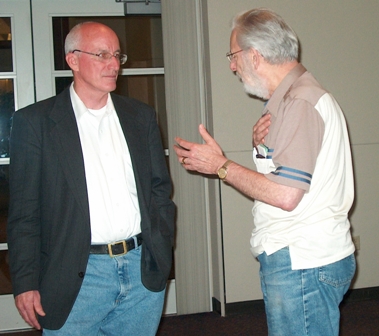
Wichita poet Michael Poage listens to Thomas Zvi Wilson
Jeanie Wilson let friends know that Thomas Zvi Wilson, her husband, died today at 12:30 pm, March 7, 2012. He influenced many Kansas City area writers as a poet, writing coach, and friend. All of us who knew him continue his life through our memories of him, and through the words he shared. To keep his fire burning, here is one of my favorites of his poems, reprinted with permission from the book The Door into the Dream (The Mid-America Press 2006):

The Winter Dream

is what we must imagine:
Whoever you are, night at last
drops you in its pocket.

In that dark vastness,
every electric bulb that's glimpsed
through  farmhouse window
is a likely star soon to burn out.

From there the roads go
nowhere, or slam into a wall
that refuses what we must imagine:
only seamless night.

For biographical information and another poem: http://deniselow.blogspot.com/2008/04/ad-astra-poetry-project-14-thomas-zvi.html

Saturday, December 27, 2008

AD ASTRA POETRY PROJECT #27


MICHAEL POAGE (1945 - )

Michael Poage has been a Kansan since 1985, when he began serving United Church of Christ congregations in Council Grove, Lawrence and Wichita. He has advanced degrees in both theology and creative writing. While a student at the University of Montana, he studied poetry with Richard Hugo and Madeline Defrees, one of the great teaching teams of the 20th century. He learned economy of words and focus. This poet’s work begins with commonplace moments that are synecdoches—parts representing the whole (as sunflowers represent Kansas prairies). Poage’s poems resemble enfolded macramé knots made of simple twine. His words are familiar yet they evoke nature’s possible theological order.

“Pelagic” in this title means living in open waters, referring most often to birds. With this poem, then, Poage might refer to how prairies resemble large bodies of water. However, he turns the sky, not ripples of grass, into the ocean, with the bird “swimming in the air.” The counterbalance is land, or “home’s street.” To extend the water comparison further, he then imagines the moon also moving within an oceanic sky. He suggests the moon is love, “beauty,” and mystery—all universal associations. The “small bird” and the moon both share the same fate as humans: all are “condemned” to struggle in “the open sea.” Home is the familiar, and the sky is the natural world with all its powerful, uncertain forces.

PELAGIC

In the breath
of a hand
we saw a small bird
swimming in the air.
We returned
to home’s street.

The moon
is a human back
caught again
in an act of passion
and condemned
with all its beauty
and common questions
to the open sea.


Education: BA, Westmont College, 1967; MFA in Creative Writing, University of Montana, 1973; Master of Divinity, San Francisco Theological Seminary, 1985.
Career: BORN, (Black Stone Press, 1975), Handbook of Ornament (Black Stone Press, 1979), The Gospel of Mary (Woodley Press, 1997), god won't overlook us, (Penthe Press, 2001), and Abundance (219 Press, 2004). He has taught at Friends University (Wichita), Wichita State University, and the University of Latvia in Riga, Latvia. Currently, he is pastor of Fairmont United Church of Christ, Congregational, in Wichita; some sermons are posted at http://www.fairmountucc.com/sermons.htm
_________________________________________________________________________________© 2008 Denise Low, AAPP 27 © 1997 “Pelagic,” Michael Poage, from The Gospel of Mary (Woodley http://www.washburn.edu/reference/woodley-press/Reviews/mary.htm ) © 2004 Denise Low, photo

Monday, December 22, 2008

ICE by Michael Poage of Wichita

I fell and as I lay thinking
about dying
I took inventory.

The moon was not quite full, not
the usual passion, rough on its one edge,
smooth around most that
I could not see, so I was reminded
of you, keeping love out
of mind, out of sight
.